
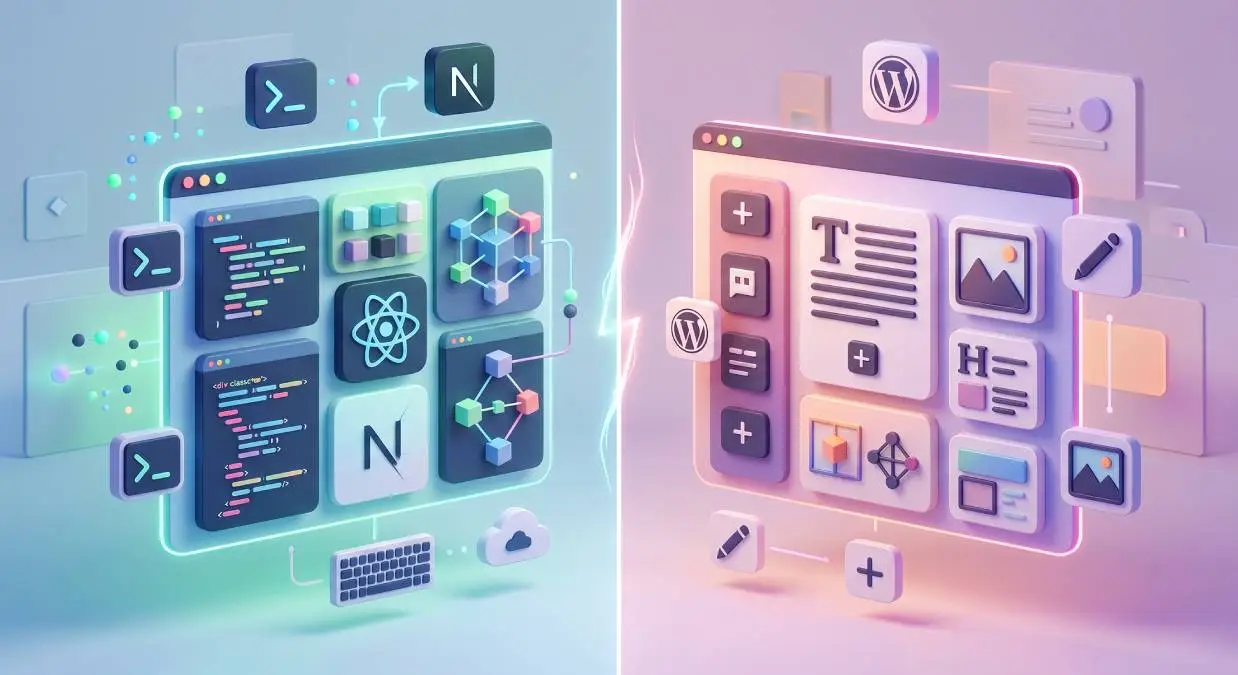
Selecting a website's software architecture dictates its growth ceiling, maintenance costs, and future scalability. The comparison between custom code and systems like WordPress does not rely on absolute superiority, but on aligning the tool with functional requirements and data volume.
Analyzing the Content Management Systems (WordPress) Path
WordPress holds the largest web market share, but execution dictates its efficiency.
The Page Builder Illusion and Performance Impact:
Relying on heavy page builders produces DOM bloat and disorganized CSS/JS files, destroying Core Web Vitals. This approach consumes server resources and increases load times, rendering it unviable for projects targeting SEO dominance or seamless user experience.
The Custom Development Approach (Custom Gutenberg Blocks):
Proper WordPress development requires discarding pre-built plugins and page builders in favor of developing custom themes from scratch based on native Gutenberg architecture. This ensures a flexible, fast dashboard with a lightweight, code-lean front-end. It allows leveraging WordPress's CMS power without compromising performance.
Analyzing the Custom Code/Full-Stack Path
The custom code route begins when standard CMS capabilities end, necessitating from-scratch architecture.
When Does Custom Code Become a Necessity?
Required when building web apps processing complex real-time data, SaaS platforms, or e-commerce systems connected to intricate webs of external APIs and ERP systems. Custom programming grants absolute control over every system layer.
Modern Development Architectures:
Custom projects require advanced environments relying on Decoupled Architecture. Technologies like Next.js generate front-end pages for superior performance, while back-ends are built using frameworks like NestJS or Node.js, integrated with advanced databases like PostgreSQL. These environments are managed via containerization (Docker) to ensure operational stability and portability, utilizing advanced caching like Redis to reduce database load.
Performance and Scalability Comparison
In custom development, microservices can be isolated to scale servers only for specific, high-load system segments. Conversely, WordPress remains a monolithic system—even with advanced optimizations and robust server configurations like OpenLiteSpeed—requiring complete server resource upgrades to accommodate massive traffic surges.
Total Cost of Ownership (TCO): Long-Term Assessment
The initial cost for custom WordPress development is lower than building a system from scratch. However, custom-coded systems, despite higher upfront costs and longer development cycles, often cost less long-term for enterprise projects. They bypass continuous plugin compatibility maintenance and common open-source security vulnerabilities.
Decision
Select WordPress (Custom Gutenberg Development) for corporate informational sites, enterprise blogs, and standard e-commerce stores requiring daily content management and balanced startup costs.
Select Custom Code (Next.js/NestJS/Docker architectures) for cloud systems, platforms requiring ultimate security for sensitive data, and projects relying on processing massive data streams and complex integrations.